You
Asked for It 2006 - Part 4
Contrasting Christianity and Islam
by Greg Hanson
Sunrise Wesleyan Church
August 27, 2006
Main Passage: John
14:1-14 (NLT)
As you know, all of the
messages this past month have been based on specific requests made by
some of you. And we got to most of those requests, and the ones we
didn’t… perhaps we’ll address those in the future. But thank you to all
who helped out this month by making your requests.
We’re going to finish up this series with a very challenging question.
Because I was asked to compare Christianity with other religions such
as Islam, Hinduism, and Buddhism. That was a great question, but also a
very broad question. And if the truth were known, the reason we’re
doing this the last week of the series is because I knew I’d need this
long to figure out how I was going to cover all of it. And my
conclusion was, I can’t. It would be impossible for us to take just the
next 24 minutes or so and cover the beliefs of all these different
religions while formulating a Christian response to them. There’s just
not enough time to do that.
So here’s what we’re going to do. We’re going to examine just one of
those other religions. And perhaps sometime we’ll do an entire series
or a LIFE Group that examines all the major religions of the world. But
for today, we’re going to talk about Islam… the religion of the
Muslims. Even then, we’re not going to be able to get into everything.
But we will be able to do a comparison of some of the major issues.
So why Islam? Why did I choose that one to talk about? Well, I chose it
because it’s the one you are most likely to encounter. Islam is one of
the fastest growing religions in the world, and the Muslim population
is increasing rapidly even here in Canada.
Let me take you back. The first recorded Islamic presence in Canada
included 13 Muslims identified in the 1871 census. By 1930, that number
had grown to a mere 700. When I was born in 1970, there were about
30,000 across the country. In 1981, there were 98,000. And in the 2001
census, there were 580,000 who claimed to be Muslim. Today, there are
an estimated 750,000 Muslims in Canada, making Islam the second largest
religion in the country with 2% of the population, (behind Christianity
which claims 72%, about 23 million affiliates).
http://www.islamonline.net/English/News/2006-01/09/article03.shtml
http://en.wikipedia.org/wiki/Islam_in_Canada
And while school policies across the country limit any mention of
Christianity, it is becoming more and more likely that your children
will be taught about Islam.
So the Muslim population is growing rapidly and gaining influence here
in Canada. How about the rest of the world? Well, there are 1.3 Billion
Muslims in the world. 21% of the population. Some estimates place that
number even higher, saying that almost one out of every 4 people in the
world is a Muslim. By comparison, Christianity is the largest religion
in the world. 2.1 Billion, or 33% of the population. Here you can see a
chart from Wikipedia.org (http://en.wikipedia.org/wiki/World_religions)
showing the breakdown of the major religions of the world. As you can
see, Christianity and Islam account for more than half of the earth’s
population.
http://upload.wikimedia.org/wikipedia/en/2/21/Major_religions_2005_pie_small.png
Here’s a map that shows you what religions are dominant where. All of
the countries that are purplish or bluish are highly Christian; all the
countries that are shades of green are Islamic. And you can see the
other religions represented there as well.
http://upload.wikimedia.org/wikipedia/en/8/8f/Worldreligion.png
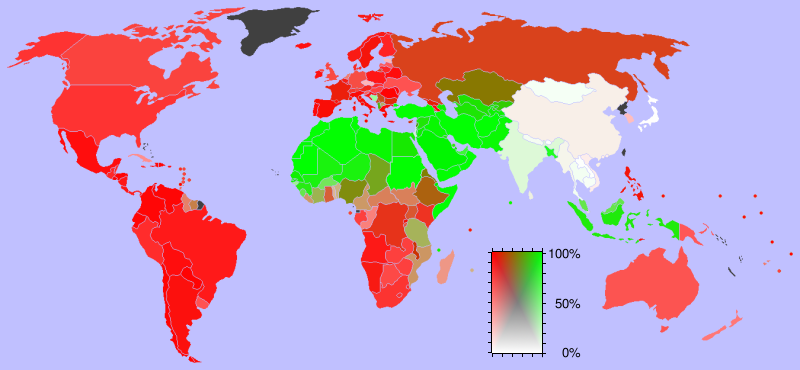
But if you want to see
just the Christian and Islamic populations, here’s a map that shows you
that. The darker the red, the more Christian. The darker the green, the
more Islamic.
http://upload.wikimedia.org/wikipedia/commons/a/ae/Christ_Islam.png
One more map. Here’s a
term you may be familiar with… the 10:40 Window. That term refers to
this area right here, between 10 degrees and 40 degrees north of the
equator, stretching from North Africa to China.
http://www.time.com/time/covers/1101030630/map/
In that window lies
almost 2/3 of the world’s population. 85% of the people there are among
the poorest in the world. Most of them are Buddhist, Hindu, or Islamic.
In fact, several of the countries within that window are close to 100%
Muslim, and their governments operate under Islamic law.
From a Christian perspective, it’s also the least evangelized part of
the world, with only three missionaries for every million Muslims. And
it’s also the most dangerous area. One Christian is martyred every 3
minutes in this world, and most of it happens in that window. About one
and a half billion people in the world have never even heard the name
of Jesus, and most of them live in here.
(http://www.vow.org/viewpoints/essays/xxxxxxx-gasque-is_jesus_the_only_way.html)
But I should point out, there’s a difference between being unreached
and being unreachable. Let me give you one example. Mongolia. In 1989,
at the same I was in University, there were only 4 known Christians
living in all of Mongolia. Today, there are over 10,000.
(http://home.snu.edu/~HCULBERT/1040.htm) The message of Jesus is
powerful and produces incredible results. Even in this very closed and
dangerous part of the world, it is possible for the message of Jesus to
have a dramatic impact.
But the question is, should it? Should Christians be actively promoting
their religion in a culture that predominantly rejects them? That’s
certainly not a new question, but it has been a hot topic in the five
years since the terrorist attacks in New York and Washington, D.C. Even
Time Magazine got in on the action… [Show cover from June 30, 2003 –
“Should Christians Convert Muslims?”
http://www.time.com/time/covers/0,16641,20030630,00.html]
The main article explored that question and criticized missionaries who
combine what it called “religious arrogance with political ignorance”.
And I actually agree with that criticism. I believe missionaries carry
a critical message that is desperately needed in these areas, but at
the same time they need to exercise some common sense and be respectful
of the laws and the culture they are entering. So does that mean maybe
they shouldn’t go?
Or how about the Muslims right here in Charlottetown? Should we tell
them about Jesus and what He’s done for them, and about His gifts of
forgiveness and life? Or should we just leave them to their own
beliefs? That would certainly be the more politically correct decision,
but would it be the more loving?
Well, let me ask you this. If your father was a drug addict and was
constantly strung out, and if his very life was in danger, would you
respect him enough to leave him to his own choices? Or would you try to
persuade him to stop and try to get him some help? Wouldn’t that be
meddling? Wouldn’t that be pushing your own beliefs on him? What would
be the more loving thing to do?
I think the loving thing to do would be to try to get him some help.
That complete stranger down the street might not lift a finger to do
anything… is that a sign of love? No, that’s a sign of indifference.
The loving thing to do would be to try to free your father from his
bondage. Even if he didn’t want your help, you’d have to do your best
to convince him, wouldn’t you? The stakes are too high not to.
Well, the stakes are even higher when it comes to Muslims. Because if
what we believe to be true is true, and if what they believe to be true
is false, then their eternity lies in the balance. What would be the
loving thing to do? Respect and love them enough to leave them alone,
headed for a godless eternity? Or respect and love them enough to point
them toward the truth?
Well, there are actually a lot of people who would tell you to butt
out. They would say that every religion is equally true, and that you
have no right to try to convert anyone. As far as they’re concerned,
all religions are just different ways to God. They would even say that
Christians and Muslims worship the same God. But are they right? Well,
they’re correct to say that there are some similarities. I think
they’re ignoring the critical differences, but there are similarities.
So let’s start with them…
Similarities between Christianity and Islam:
1. Both believe
in only one God. (monotheism)
This is affirmed in both
the Bible and in the Qur’an…
Deuteronomy 6:4-5 (NLT)
“Hear, O Israel! The LORD is our God, the
LORD alone. And you must love the LORD your God…”
And in the Qur’an, it says…
Sura 112:1-4
“Say: He is God, the One and Only; God, the Eternal, Absolute; He
begetteth not, nor is He begotten; And there is none like unto Him.”
But is that one God of Christianity the same one god of Islam? Is the
Father of Jesus the god of Muhammad? Is Yahweh – the name of God in the
Old Testament – the same as Allah? Well, we’ll come back to that later.
2. Both are
guided by holy books.
Christians have the
Bible. We believe that over the span of the centuries God Himself
inspired and led the prophets and apostles and others who wrote the
various books included in the Bible, and that He protected those
writings from errors. And we believe that those writings have been
transmitted and translated to us today without compromise of any
essential doctrine. It’s the Word of God that tells us how we can be
made right with God and know Him, how we can receive His gifts of
forgiveness and eternal life, and it guides us how to live from day to
day.
2 Timothy 3:16 (NLT)
All Scripture is inspired by God and is
useful to teach us what is true and to make us realize what is wrong in
our lives. It straightens us out and teaches us to do what is right.
You may be surprised to learn that Muslims also value the Bible,
although they also consider it to be corrupted. They believe Abraham
was a Muslim and Jesus was a Muslim. And they claim many of the
prominent people in the Bible as their own.
But it would be through Muhammad in the seventh century that they would
receive what they consider to be their true Scriptures, the Qur’an.
According to Muslim belief, the Qur’an was given to Muhammad by the
angel Gabriel over the course of 23 year. And they consider the Qur’an
to be so divine in the original Arabic, that they do not view any
translation as being authoritative. It’s got to be read in the Arabic
in order to be a true revelation.
3. Both have
the goal of a divine future.
In some religions, life
is like the movie Groundhog Day. You keep reliving the same experiences
all over again. Life just goes in circles, and there’s reincarnation
after reincarnation. But for both Christianity and for Islam, there is
the goal of a divine future. Life is heading somewhere.
4. Both have
the task of conveying their message to the world.
Both Christians and
Muslims believe that their message is for everyone. However, the
methods used to spread the two messages are very different. Going back
to the very beginning… Jesus used persuasion and storytelling and logic
and miracles, but never resorted to violence. Even when he was
physically attacked and eventually crucified, He never struck back.
Instead, He prayed for their forgiveness. Same with His followers. In
Acts 7, Stephen prayed for his attackers even as they stoned him to
death. Almost all of the disciples were martyred, and never fought
back. Early Christians were routinely persecuted and killed and even
fed to lions, but always responded peacefully.
The beginnings of Islam are quite different. When Muhammad first
started preaching his new religion, he was hoping to gain acceptance by
Jews and Christians. But when his message was rejected as being false,
he became more and more hostile toward them. His earliest writings were
quite sympathetic toward both Jews and Christians, but if you read
through them chronologically, you’ll discover that he became more and
more hostile. And eventually he formed an army to force the spread of
Islam, even wiping out entire communities that rejected him. Islam was
essentially spread with the sword; it was their “holy war” or jihad.
You can read about that in any encyclopaedia. Right from the get-go,
not exactly a religion of peace. I know that’s not politically correct
to say, but it’s not my job to be politically correct.
But yet, while the methods are different, both faiths believe they have
an obligation to spread their message.
On the surface,
Christianity and Islam can appear very similar. They can sound like
they’re the same faith, just with different names. But I can assure
you, they are not. You will never hear a Muslim saying that they are
the same. They know that Christianity and Islam are diametrically
opposed, as are all religions. And while Islam does affirm some of the
teachings of Christianity, it denies the foundational beliefs of
Christians.
But there’s a growing number of people in our society who are simply
uninformed about the differences. One poll of Americans revealed that
44% of them agree with the statement, “the Bible, Qur’an, and the Book
of Mormon are just different expressions of the same spiritual truths.”
Many people today know so little about the different faiths that they
believe they are interchangeable.
One of my favourite authors and speakers is Ravi Zacharias, who is an
expert when it comes to the philosophy of religion. And he has said…
“People often say that religions are fundamentally the same and
superficially different. May I reverse that for you and tell you that
religions are fundamentally different and at times superficially
similar.”
~ Ravi Zacharias (rzim.org)
But what does it matter? Even if they aren’t the same, aren’t they
basically equal? Aren’t they all just different ways to God? It’s
interesting… in my observation, that question is only ever asked about
Christianity. Christianity is the faith that takes the hit for being
exclusive, but the truth is that every religion in the world has a
point of exclusion.
Even Hinduism, which claims to be inclusive, will not compromise on the
doctrines of Karma and Reincarnation. Those are foundational, and if
you won’t accept them, then you cannot be Hindu. Buddhism was born out
of the rejection of the Hindu claim of the authority of the Vedas and
the caste system. And both Christianity and Islam have some very
exclusive claims, too. And we’re going to talk about some of those
differences. And as we do so, I hope we can take an honest look at
Islamic beliefs while remaining respectful of Muslims, who hold their
beliefs as dearly as you hold yours.
But before we get to that, let me just explain that this exclusivity is
essential. If religion is the search for truth, then truth by its very
nature is exclusive. If something is true, then it is only true because
something else is false. Even in denying exclusivity, you would be
excluding those who believe in exclusion. In the field of logic, this
is called the law of non-contradiction. This means that two
contradictory statements cannot both be true in the same sense.
“Even those who deny unique and exclusive approaches to truth would
insist that their own approach is unique and exclusive! Otherwise, they
would have nothing to say! Truth, by definition, is therefore exclusive
and narrow. It has to exclude errors in order to qualify to be truth.”
~ L.T. Jeyachandran
(http://www.rzim.org/noindex/jtprint.php?seqid=42)
So as we examine just a few of the differences between Christianity and
Islam, then these are your choices:
• Either Christianity is true and Islam is false, or…
• Islam is true and Christianity is false, or…
• Both Christianity and Islam are false.
They cannot both be true. They are contradictory. So what are some of
the major differences? There are several, and at the end I’m going to
give you a sheet that summarizes many of them. But I want to summarize
just three of the major areas of difference…
Major Differences:
A. The nature
and identity of God
•
Christians believe in the Trinity – the doctrine that there is one God
expressed as three persons.
This is the understanding that God exists as three distinct, co-equal
and co-eternal persons who all share the same divine essence or being
or nature. This can be seen in passages such as…
John 1:1, 18 (NLT)
In the beginning the Word already existed.
He was with God, and he was God…
No one has ever seen God. But his only Son, who is himself God, is near
to the Father’s heart; he has told us about him.
Colossians 2:9 (NLT)
For in Christ the fullness of God lives in a
human body…
Matthew 28:19 (NLT)
“Therefore, go and make disciples of all the
nations, baptizing them in the name of the Father and the Son and the
Holy Spirit.”
Basically, the doctrine of the Trinity says that The Father is God,
Jesus is God, and the Holy Spirit is God, but there is only one God.
And it’s been summed up in what’s known as the Shield of the Trinity…
• Muslims refute the Trinity as a
belief in three gods.
Their foundational creed states that “There is no god but Allah”. And
so to them, the Christian concept of God is polytheistic and profane.
• Christians believe God has
revealed Himself and is knowable.
John 1:14 (NLT)
So the Word became human and lived here on
earth among us… And we have seen his glory, the glory of the only Son
of the Father.
• Muslims believe God is hidden and
is unknowable.
In Islam, there is no concept of having a personal relationship with
Allah. There is no image of Allah interacting with Creation. There is
no perception of a loving, caring God. Allah is presented instead as
almost an angry god of justice with a strict list of warning which must
be obeyed or suffer the consequences.
Yes, the Christian God is a God of justice, but that justice is
tempered with love, compassion, mercy, holiness, and grace.
B. The nature
of Jesus and what He did.
• For
the Christian, Jesus is understood to be divine.
We’ve already talked about how Christians view Jesus as being one of
the persons of the Trinity, and therefore God. In the passage that
Karen read earlier, Jesus claimed to be the one and only way to God the
Father. He Himself is the Truth. He is the source of Life. On the other
hand…
• Muslims see Jesus as just a
prophet – nothing more, nothing less.
Oh, they claim to respect Jesus and highly esteem him in the Islamic
faith. He’s even talked about in the Qur’an. But do you understand what
a demotion it is for Jesus to be taken from being God to being
considered just a good prophet?
• The Christian hope is founded in
the sacrificial death and resurrection of Jesus.
As Paul expressed it in 1 Corinthians…
1 Corinthians 15:17, 20 (NLT)
And if Christ has not been raised, then your
faith is useless, and you are still under condemnation for your sins…
But the fact is that Christ has been raised from the dead.
To the Christian, the death and resurrection of Jesus are critical.
• To the Muslim, the crucifixion
and resurrection never occurred.
To the Muslim, Jesus was not divine, he did not die on the cross, his
death was not a sacrifice for sin, and since he was not crucified there
was also no resurrection. That right there is the very essence of the
Christian message, and so by denying who Jesus was and what He did,
they completely discount the “Christ” of “Christ-ianity” and reject the
heart of our faith.
“There can be no Christianity without the cross. There can be no Islam
with the cross. The crucifixion of Jesus, the cross of Christ is the
great dividing point between these two vast world religions.”
~ Timothy George
http://www.pastors.com/article.asp?printerfriendly=1&ArtID=3970
Plus, while they do recognize Jesus as a great prophet, their greatest
prophet was Muhammad. In fact, their full profession of faith states,
“There is no god but Allah and Muhammad is His messenger.” They claim
to follow Allah, but Muhammad is their example.
Here’s something you might find interesting. One great Muslim writer
from the Middle Ages wrote…
“When cutting your nails you must begin with the little toe of the
right foot and finish with the little toe of the left foot.”
~ al-Ghazali
Wow, that’s pretty specific. Shera would be happy if I just cut my
toenails… she doesn’t care how; any old way would do. Why would a
Muslim want to get this specific about cutting toenails? Because that
is how Muhammad supposedly cut his. That’s the level of reverence the
Muslim has for Muhammad… much more than they have for Jesus.
C. The current
condition and future hope of humanity.
•
Christians believe that sin entered the human race through Adam.
And that sin has been passed down through the generations and has
corrupted all of Creation. And so we are in desperate need of a Saviour.
Romans 5:12 (NLT)
When Adam sinned, sin entered the entire
human race. Adam’s sin brought death, so death spread to everyone, for
everyone sinned.
• Muslims reject the concept of
“original sin.”
They believe that Adam sinned, yes, but they also believe he was
restored and that there were no permanent consequences of his sin. And
since there is no original sin, there is no need for a Saviour.
• Christians have the assurance of
a future with God.
Jesus told us that we can know that our future is secure.
Ephesians 1:14 (NLT)
The Spirit is God’s guarantee that he will
give us everything he promised and that he has purchased us to be his
own people.
• Muslims never really know if
their future is secure.
Actually, that’s not entirely true. There is one guarantee, according
to Islamic belief. If a Muslim is killed in a Jihad, or a holy war,
then they are assured of Heaven. Which as you can understand, feeds the
Islamic terrorist mindset.
• For the Christian, salvation is
based on God’s grace.
Salvation is a free gift of God’s grace that cannot be bought or
earned. It’s a gift, and it’s available to all who will receive it.
Ephesians 2:8-9 (NLT)
God saved you by his special favor when you
believed. And you can’t take credit for this; it is a gift from God.
Salvation is not a reward for the good things we have done, so none of
us can boast about it.
• For the Muslim, salvation is
determined by their good works.
For them, Allah decides if they have been good enough to gain entrance
into Heaven. And it’s based on what they have done.
So as you can see, there are critical differences between Islam and
Christianity. The two faiths cannot be merged. Either Christianity is
true and Islam is false, or… Islam is true and Christianity is false,
or… Both Christianity and Islam are false. They cannot both be true. As
Bill Hybels explains…
“The law of non-contradiction says that positions that are different
from one another cannot be equally true. You’ve got to figure out what
you believe and where you’re going to drive that stake in the ground
and say, ‘On the evidence—on the search that I’ve done—this is what I
believe. This is what I’ll stake my life and my eternity on.’”
~ Bill Hybels
http://www.sermoncentral.com/print_friendly.asp?ContributorID=&SermonID=50638
Where do you stake your
life? Have you really explored your faith, or are you just paying lip
service? Do you know what you believe, so that you can recognize what
is true and what is false? Where do you stake your eternity?
As we finish up here this morning, I want to show you a video. In this
video you will see how Muslims understand that Islam and Christianity
are in no way the same faith. You’ll see how fiercely they oppose
Christianity. And you’ll also see how Jesus can transform a life… and a
community… and the world.
Video – Essentials 4-6: IMB Journey
|